
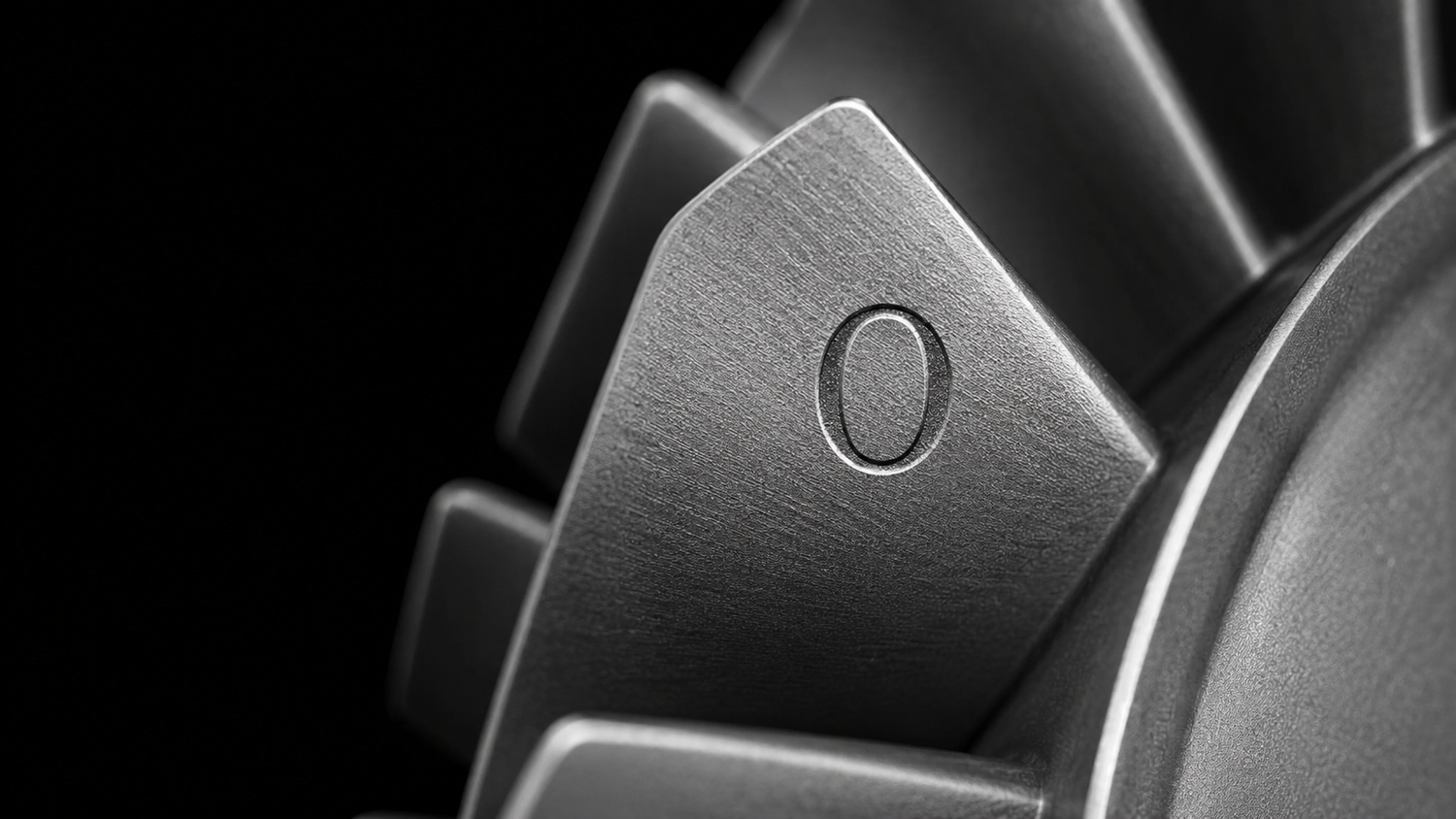
You'll never see the letter "o" we engraved on the turbine fan inside your Dymona. It's about 8 millimeters across. Anodized matte. Same shape as the "o" in our wordmark. The first time you'll be close enough to read it is when the motor wears out in a decade or so and our workshop opens the housing to put in a new one.
We engrave it anyway.
This essay is about why.
What we engrave
Four parts, on every Dymona we ship:
- Turbine fan blade. A small "o" on one blade, etched 0.08mm deep. Catches light at certain angles when the fan is still — you'd see it if you opened the dust path with a flashlight, which we don't recommend.
- Motor housing rim. The full DYMONA wordmark, engraved deep enough to feel with a thumbnail. 0.12mm depth. Hidden behind the dust bin gasket.
- Aerospace aluminum body, inner wall. A serial number cut by 5-axis CNC. Tolerance ±0.005mm. Only visible if the housing is split, which only happens during workshop repair.
- Handle clip, inside surface. "Hand-finished · München" in small capitals. Behind a plastic insert that snaps in last.
None of these affect performance. None of them are required to make a working vacuum. None of them are visible to a buyer through normal use, or even through abnormal use short of disassembly.
Why we do it
Three reasons. They get progressively stranger.
One — it's how the craft makes itself accountable
When you know there's a hand-engraved mark on a part that goes into every unit, your hands behave differently. The person doing the engraving slows down. The person assembling slows down. The person finishing — the fifth or sixth stage of finishing on an aluminum body — slows down because they're now part of an unbroken chain of people who didn't take a shortcut on a part nobody would check.
It's the same logic that makes a German workshop different from a contract manufacturer running 50,000 units a month. Speed and shortcuts are easier to take when nobody on the line knows there's a thing somewhere that would catch them.
Two — it tells you something we can't tell you in marketing copy
Every vacuum brand says "premium materials" and "precision manufacturing." Most of them mean it about as much as a fast-food chain means "fresh ingredients."
We can't change that the words are devalued. What we can do is leave evidence that we mean them. The evidence is the engraved "o" on the turbine fan. We will never use it in an ad. It will never appear on a product page. It exists between us and the people on our line and the small fraction of buyers who, one day, will open up a 12-year-old Dymona to replace the motor and find it there.
That's the audience.
Three — it's a memo to ourselves
Every founder eventually has the conversation where someone with an MBA explains that 50% of the cost of hand-finishing could come out without anyone noticing. They will be right about the noticing.
The engraved parts are a stake in the ground. As long as the engravings are there, we know the line hasn't been quietly outsourced. As long as the line hasn't been outsourced, the rest of the assumptions a buyer makes about Dymona — Berlin design, Munich manufacturing, two-year warranty without questions — still hold.
The day we stop engraving the inside of the motor housing rim, something else has slipped first. It's a tripwire.
What it costs us
Honest answer: about €4.20 of additional cost per unit, depending on the part. Engraving the turbine fan adds ~30 seconds to one of the assembly stations. Engraving the motor housing adds about a minute including QA. The serial number on the aluminum body inner wall is part of the CNC pass so it's effectively free.
Multiplied across the volume we're at now, the engravings cost us about a single full-time engineer's salary per year. We've been asked if it's worth it.
The answer is yes. But the math behind that answer is upstream of margin — it's about what kind of company we want to be after the second financing round, after the first big retail bid, after the first time we have a meaningful inventory backlog and someone proposes "just for this quarter" trimming a finishing pass.
What you'll never see
The point of this essay is that you'll never see what we're describing. The engravings are not part of the value you bought. The value is the 25,000 Pa suction, the 60-minute runtime, the 1.8 kg balance, the HEPA-13 filter that captures 99.95% of 0.3-micron particles. That's the product.
The engravings are for the people who built it. They're for the small workshop outside Munich that has, after the last finishing pass, a process that no algorithm or contract manufacturer would ever propose, and only a slightly stubborn German workshop would accept as worth doing.
If you ever do open up a Dymona — repair, replacement, curiosity — you'll find the engravings. That's the only audience that matters for them.
In the meantime, your vacuum cleans. The rest is between us and the part.
— Dymona Studio · Munich workshop · 2026

Leave a comment
This site is protected by hCaptcha and the hCaptcha Privacy Policy and Terms of Service apply.